Monday, December 31, 2012

The Loved Ones (Australia; Sean Byrne, 2009)


     Some people just can't take rejection. Brent (Xavier Samuel) learns this the hard way when he turns down Lola Stone's (Robin McLeavy) request to accompany her to the school dance. The fact that he has a girlfriend matters little to Lola, who ultimately gets her date with Brent whether he likes or not. In the vein of Hard Candy (David Slade, 2005) and Audition (Takashi Miike, 1999), Loved Ones examines the gender power shifts involved when a woman/girl is in control of a man/boy. However, unlike the other mentioned titles, the male victim in Loved Ones isn't presented in  a way that makes us feel he deserves it, which in turn removes any sympathy we could have possibly felt for the sadistic female perpetrator. While the film somehow attempts to explain Lola's behavior as a consequence of the pressures imposed by our increasingly media-centered society on today's youth, the idea is too-quickly passed over and weakly presented in the first place. Which leaves us with just a crazy, psychotic teenage serial kidnapper/murderer who can't take no for an answer. Far from being detrimental to the picture's enjoyment, the lack of conclusive explanation for Lola's erratic behavior makes the film that more enjoyable as it increases the viewer's discomfort and intensifies our reaction to the sadism portrayed on screen. It also accentuates our satisfaction when Brent finally fights back.

Monday, December 17, 2012

Lawless (USA; John Hillcoat, 2012)


     Being a big fan of the 2005 western The Proposition,  I was looking forward to this new collaborative effort from writer Nick Cave and director John Hillcoat detailing the prohibition-era tribulations between the bootlegging Bondurant brothers (Shia LaBeouf, Tom Hardy and Jason Clarke) and Virginia Commonwealth appointed Deputy Charlie Rakes (Guy Pearce), the latter demanding paybacks in exchange for letting them operate their business in peace. Their refusal to oblige puts them at odds with Rakes and jumpstarts a small war in the Virginian mountains where "stills" (distilleries) are shut down one after the other. Similar to The Proposition, the law is shown here to be lacking the moral fabric that it claims to instill, a fabric that is incidentally embodied by those deemed criminals. However, unlike the former picture, Lawless suffers from an uneven script that has a hard time figuring what exactly it is trying to say. As the characters' exploration is for the most part limited to the surface, the chronology is vague and the pace perhaps too inconsistent. Hillcoat's directing, on the other hand, goes a long way in redeeming whatever shortcoming Cave's screenplay may have. The same goes for the acting. While LaBeouf's character makes incredibly stupid choices, making it hard to sympathize with him even when a mouthful of blood and teeth reduces his speech to mumbles (courtesy of a shotgun barrel to the face), the performances are for the most part very strong and  engaging. Tom Hardy is especially surprising as Forrest Bondurant, the oldest and baddest sibling of the Bondurant clan who is starting to believe the legends told about his purported immortality. Guy Pearce (who was the troubled lead in The Proposition) is also chillingly disturbing in his portrayal of the sadistic dandy Rakes. Perhaps the biggest disappointment acting-wise, however, was the underused talents of Gary Oldman as gangster Floyd Banner. Not only was his screen time too small but Banner's role in the Bondurants' affairs is barely explored as his involvement feels arbitrary and unclear. Finally, the film is worth watching if only for the impressive soundtrack that includes a few tracks by Cave himself (of course) and other fittingly gripping pieces. 

Tuesday, December 4, 2012

Skyfall (UK/USA; Sam Mendes, 2012)


     Numerous times during the picture, M (Judi Dench) describes the world in which James Bond operates as existing in "the shadows" of the one perceived by the general population. Fittingly enough, this hidden world of top secret operations is brilliantly evoked by often having the actors stand in front of an excessively bright background and therefore transforming them into mere silhouettes, literally pitting shadow vs. shadow when done during fighting sequences. Additionally, seeing as the use of silhouettes is prominent in many of the series' opening credits sequences, the shadow motif extends the artistic nature of the credits to the film itself. This stylistic interpretation is only one of many elements of sophistication the photographic team of Sam Mendes and Roger Deakins brings to the Bond table. While I find the debate over whether or not this is the 'best Bond film ever' irrelevant, I can say with confidence that, form-wise, this was the most satisfying experience I personally had watching a Bond film. I must admit, however, that I'm far from being the biggest Bond fan out there. On the other hand, I have been a long-time fan of both Mendes and Deakins (especially his extensive work with the Coen brothers), their new collaboration being what initially triggered my interest for the picture and the reason why the result is one of the most memorable installments featuring Ian Fleming's troubled spy.

Wednesday, November 21, 2012

The Man with the Iron Fists (USA/Hong Kong; RZA, 2012)


       RZA has taken his passion for classic martial arts flicks to the ultimate level, not only co-writing, directing and, naturally, composing the music for this outrageous battle-fest, but also casting himself as the title character, a Buddhist-trained runaway freedman who replaces his severed forearms with, you guessed it, iron  fists (although he may not be the most convincing actor around, his lack of subtlety is beneficial here). Including much of the genre-related factors that one would expect from a homage to Shaw Bros-like kung fu movies, such as feuding animal-named warrior clans, a beautifully treacherous madam, acrobatic action and Gordon Liu, Man in the Iron Fists goes beyond being a mere tribute to its source material and becomes an entity that stands on its own. With exaggerated blood splatter à-la-Riki-Oh, some of the most caricatural characters to ever grace the silver screen (Silver Lion, with his Artist-formerly-known-as-Prince wig, is especially hilarious) and stylish photography that constantly strives to be cool, the result is quite an impressive spectacle. However, while some of the fighting sequences are graceful and poetic (see the creative concept of the Gemini warriors), the bulk of the action is greatly distorted by choppy editing and brusque camera movements. This detail is compensated, on the other hand, by appropriately over-the-top performances, sensational violence and beautiful ladies, all the instant gratification one would expect from a satisfying exploitation film.

Tuesday, November 20, 2012

Holy Motors (France/Germany; Leos Carax, 2012)


      If you like conclusive answers with your cinema, Holy Motors may not be the film for you. On the other hand, if you seek cinematic creativity that offers the viewer's imagination multiple possibilities for extrapolation, then you've come to the right place. While one scene halfway through the movie partially sheds some light on the nature of Mr. Oscar's (Denis Lavant) series of bizarre 'appointments' throughout the city of Paris, the film's strength lies in the maintained magical mystery surrounding Oscar's disparate personalities that he creates in the dressing room located in the back of the limousine that drives him from one performance to the next. From Mr. Merde kidnapping Eva Mendes to a killer who dresses his victim up as himself, Mr. Oscar's face changes more often than Orlando Hudson changes baseball teams. The increasing strangeness of each 'appointment' emphasizes the elastic nature of performance in a way that underlines the unreliability of images as grounds for truth-seeking. Packed with cultural allusions, complex characters and breathtaking imagery, Holy Motors, through its inquisitive entertainment, realizes like few others the full potential of what cinema can be.

Friday, November 16, 2012

The Master (USA; Paul Thomas Anderson, 2012)


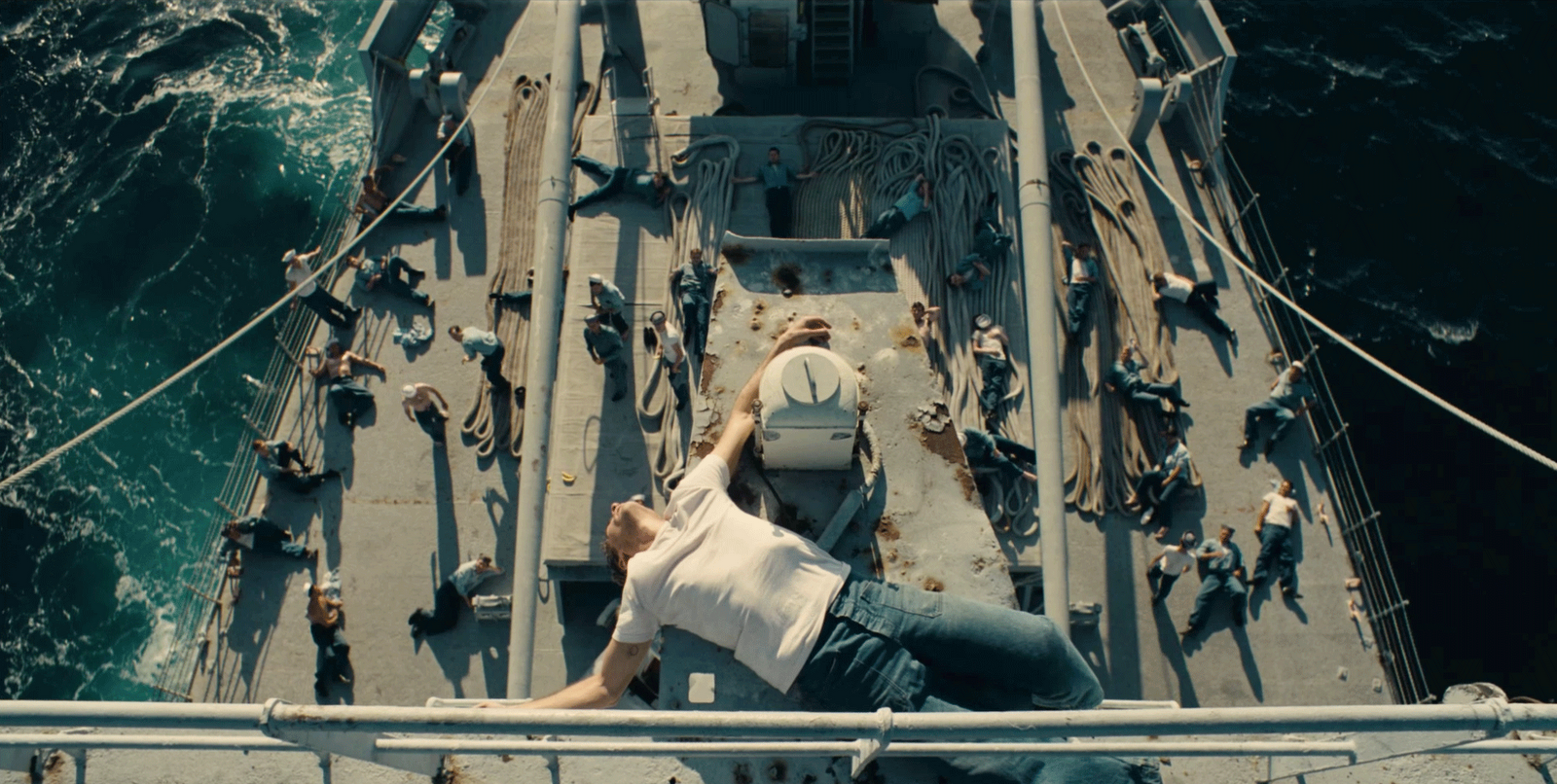
     P.T. Anderson has come a long way since Hard Eight (1996) and Boogie Nights (1997). With The Master, he demonstrates a maturity in style that goes beyond quick dolly-ins and long, sweeping camera movements, shifting the attention away from his direction and towards the players who make his unconventional story come alive. Without a doubt The Master is a performer's piece, and quite a perplexing one at that. Remaining vague as to character motivation (greed, insanity, lust, love?), Anderson is a master himself at creating expectant tension out of what could easily be considered very boring and non-eventful situations, an achievement mainly made possible by his ability to bring out the best in his actors (and letting the camera roll). The 'processing' scenes pitting Joaquin Phoenix's deeply troubled WWII veteran against Philip Seymour Hoffman's Welles-like cult leader are powerful and satisfyingly disturbing. Phoenix is especially captivating in his hunched-over instability, delivering here what could possibly be his strongest performance to date (although I haven't seen Two Lovers yet). The seeming simplicity of the film's story-line masks a deep complexity that is embodied through its ambivalent, hard-to-sympathize-with characters. This complexity eventually gets transposed to the evolution of the narrative itself, culminating in events that seem to happen out of the blue and with questionable roots as to cause and effect (most notable is the phone in the movie theater scene). By raising more questions than answers (which might be why I've read so many negative comments from viewers), Anderson once again explores the intangible fabric of human nature by stretching the conventional limits of cinematic expectations. While The Master may not appeal to viewers in search of full-on entertainment, it is worth watching for the haunting performances alone (and just when you thought Philip Seymour Hoffman couldn't get any better).

Wednesday, November 14, 2012

Flight (USA; Robert Zemeckis, 2012)


          I thought it interesting, and slightly curious, that Zemeckis, waiting 12 years to direct a new live-action feature after 2000's Castaway, would once again tackle a narrative revolving around a plane crash. However, where Castaway was relatively refreshing in its principal subject matter (isolation on a deserted island), Flight is not showing us anything new about its own (repressed alcoholism). Instead, its main goal seems to be to deconstruct Denzel Washington's typical screen persona, mainly resulting in the revelation of a vulnerability that eventually leads him to lose all self-control (and get romantically involved with a white woman, typically a big no-no for Denzel), something we haven't seen him do very often before the end of a picture. Even when Washington portrays morally ambiguous characters (Man on Fire, Training Day, American Gangster) he seems to maintain some degree of authority over the events unfolding around him, before an untimely death deprives him of the privilege to continue doing so. In Flight, the only time Whip is in complete control is when he is crash-landing the free-diving jumbo jet during what is arguably the film's most memorable scene. Throughout the rest of the picture, he is at the mercy of his self-denied addiction around which the bulk of the film revolves. Unfortunately, this loss of control is predictably overcome and by the end of the picture we are left with good-old repenting Denzel who has discovered the redemptive powers of the grace of God. While there is technically nothing wrong with the finished product (on the contrary, everything is in fact brilliantly executed) the script lacks any real creative insight when it comes to character exploration. Without Washington's powerfully convincing, persona-shattering performance, Flight might have been just about another barfly refusing to end his days of wine and roses.