Tuesday, October 23, 2012
Hatfields and McCoys (USA; Kevin Reynolds, 2012)
Watched part 2 of this engaging mini-series yesterday and while I have yet to see the conclusive episode, I still feel I've experienced enough of it to get the idea of what it has to offer (also I haven't watched anything really noteworthy lately). In dealing with the notorious 19th century family feud that existed between the McCoys of Kentucky and the Hatfields of West Virginia, this product of the History Channel is another strong argument for the present state of American television being much stronger and offering better material than the recent track record of mainstream American cinema. While the wide scope of the events covered in the series makes its subject ideal for television, its appeal strongly stems from its cinematic qualities, including striking photography, convincing production and costume designs, and generally strong performances (Tom Berenger's gritty portrayal of Jim Vance is especially powerful). The prevalent animosity that escalates between the clans of patriarchs Randall McCoy (Bill Paxton) and Anse Hatfield (Kevin Costner) leads to blood, blood and more blood as rebellious sons and gullible daughters constantly undo the possibilities for peace their parents attempt to shape; until peace just isn't an option anymore. Getting better as he gets older, Costner's performance and attention to historical detail make Hatfields and McCoys a strong and welcome addition to the recent Western television series such as Deadwood and Hell on Wheels, making one wonder when the movies are finally gonna catch up.
Monday, October 22, 2012
The Land of Hope (Japan; Sono Sion, 2012)
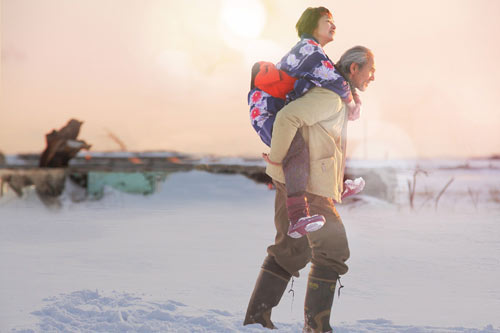
More tamed in content than the previous Sion Sono pictures that I have seen, The Land of Hope still manages to shock its audience with its inclusion of psychologically-questionable characters who all react differently to the omnipresent threat of radiation. Following the tsunami-caused explosion of a Japanese nuclear power plant in a small town, the lives of the Ono family are disrupted when their home becomes the cut-off line for the disaster's infected area, the radiation apparently unable to cross over yellow, "do not cross" police tape. This absurd treatment of radiation risk and containment sets the tone for the film's exploration of human reaction to invisible danger. From radiation phobia to the blissful ignorance of what can be assumed to be Alzheimer's disease, the film's characters all must learn to cope with both they're own fears and those of the ones they love. As families separate and villages grow deserted, the will to survive is continuously tested as individuals must learn to adapt to this inescapable result of technological 'advancement'. Beautifully shot as usual, Sono's latest effort is filled with low-key moments bursting with high emotion and sporadic humor that saves them from becoming all-out tragic. Finding hope in the most unusual places (even death), Land of Hope gracefully forces its audience to assume and confront their own views regarding one of today's most imminent geographical concern.
Sunday, January 15, 2012
The Black Power Mixtape 1967-1975 (Sweden; Goran Olsson, 2011)
Having recently finished a 13-week class on Blaxploitation film, the study of which cannot be complete without discussing its close ties to the Black Power movement that was gaining popularity at the time its production, viewing this Swedish perspective on the BP years was an insightful glimpse through a foreign eye (which I incidentally also possess) of one of the most defining moments of 20th century America. As a weak-but-fierce Angel Davis herself proclaims during a hunger strike behind bars, to question the need for violence in such a revolution is to be ignorant of the daily realities facing the black community (at that time?). This ignorance is what this film seems intent on rectifying. Whether it succeeds or not is beyond my knowledge, seeing as all I have as an understanding of these events is a collection of various processed memories that each want to paint the era in a specifically defining light. However, one cannot deny the film's worth in providing us with deeply moving and profoundly revealing bits of stock footage. Stokely Carmichael, Angela Davis, Bobby Seale and many others are heard in the flesh, giving us a firsthand account of the roots and purposes of the Black Power philosophy. These images are supported (but never visually replaced) by voice-over commentaries spoken by various influential figures, some of which are seen in the footage and awarded the benefit of being able look back on themselves and reflect on these unforgettable years. While the film seems to veer towards the melodramatic side as it progresses, the images conserve their evocative power until the very end.
Monday, July 18, 2011
The King of Devil's Island (Norway/France/Sweden/Poland; Marius Holst, 2010)
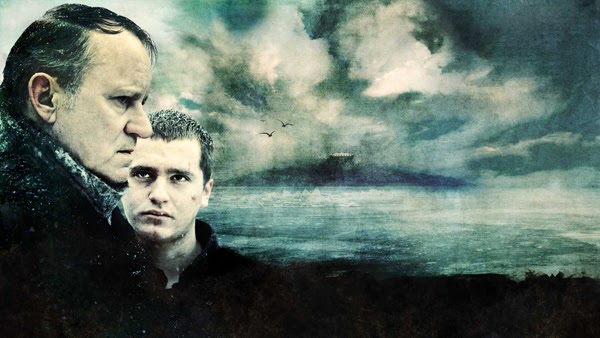
Saw this yesterday at the Fantasia Film Festival. Although, as my friend David pointed out, it isn't your typical Fantasia movie, it remains a great festival selection, and a powerful film. In 1915, Erling (Benjamin Helstad) is sent to Balstoy, a Norwegian prison/work camp for boys located on an isolated island. His hard-headedness quickly causes him to clash heads with the camp's various authority figures, including ruling Governor Bestyreren (Stellan Skarsgard), and helps to feed a growing longing for escape. However, his dreams of freedom make a momentary transition to the back burner when the perverted actions of his unit's Headmaster (Kristoffer Joner) lead Erling and his new-found friend Olav (Trond Nilssen) to take a stand in the name of justice. Joyful moments being rare, King of Devil's Island still manages to keep the viewer's hopes up by inserting a number liberating scenes that hint towards an eventual overthrow of the corrupted status quo. While an insurrection does get underway, a stubborn rebellious sprit alone proves insufficient ammunition to keep the army at bay. Ultimately, the film's signature grey-and-blue aura prevails, reflective of the prison's shaky waters and how it rocks the metaphorical boat Bestyreren constantly compares it to.
Wednesday, June 15, 2011
Savage Streets (USA; Danny Steinmann, 1984)
There's just something about bad 80s movies I simply can't resist. Just seeing the posters for some of these films makes me go "I gotta see this!" even though I am certain of their ultimate mediocrity. It's as if all of the usual conventions found in mainstream Hollywood films are thrown out the window, the focus being on easily exploitable material, a.k.a B.T & A (blood, tits & ass). Proving once again that Linda Blair can't act to save her life, this girl-power revenge flick is as trashy as they come. The antagonists are over-the-top disgusting perverts whose decision to rape a young, deaf high school girl leads her older sister Brenda (Blair) to go on a killing streak, chasing down the perpetrators one by one. While the deaf-victim/revenge angle reminded me of Ms. 45 (1981), Savage Streets possesses none of the startling grittiness of Abel Ferrara's cult classic. It rather feels like a Troma picture gone wrong (which is saying a lot). However, like so many titles of 80s cinema, the reasons that make the film so terrible are the same that make it so enjoyable. Over-acting, bad lighting, shaky out-of-focus camera work and signature 80s synthesizer music all work together to create one of the best bad movies I've had the luck to see.
Tuesday, June 14, 2011
Ace in the Hole (USA; Billy Wilder, 1951)
To what lengths will a reporter go to make a good story great? That's the question Chuck Tatum (Kirk Douglas) attempts to clarify in Ace in the Hole, Billy Wilder's rendition of the newspaper movie. Having been successful in almost every other genre (except perhaps the western), I find it surprsing that Ace is known to be a flop in his illustrious career. Much darker and cynical then Hawks' His Girl Friday (which incidentally Wilder remade himself almost 25 years later as The Front Page, taking back the original title of the play), the film paints a rather bleak picture of the media in which deception, exploitation and self-destruction seem to be the prevailing norm. When big-city-exiled hotshot reporter Tatum lands himself in Alburquerque, NM following a series of job terminations, his enthusiasm for big news is left wanting when big headlines talk of rattle snake hunting festivals. When he accidentally comes across a man trapped in cave (Richard Benedict), he sees the big story he was looking for and his way back into a big-city newspaper. Using his loose-lipped, fast-talking big-city edge, Tatum delays the rescue to stretch the story out, turning this small-town tragedy into a big carnival (the title to which it was changed following poor intitial reception). As he deals with contemptuous editors, the victim's treacherous wife and his own moral dilemna, Tatum soon grows wary of his own profession as his actions ultimately make up the difference between life and death.
On par with many other films about the media (Sweet Smell of Success; Network), what distinguishes Ace is its setting. As opposed to being set in the urban jungle, as most newspaper films are, we are thrown into the desert, a spot as remote from civilization as it is from viewers consciousness. In doing so, Wilder examines media practices outside of its normal turf of manipulation, dealing with small-town citizens who may not be as used to the tricks of the journalism trade as big-city dwellers. When not taken for granted, the exploitations of the media are seen to cause harm and irreperable damage, serving to destroy the communities they purport to enlighten.
Wednesday, June 8, 2011
In Cold Blood (USA; Richard Brooks, 1967)
Like Truman Capote's book on which it is based, In Cold Blood is a reconstruction of true events presented in fiction form. The gripping result is a testament to the power fiction has in shaping emotions and ironically making us sensitive to real events. Taking the book's two murderers as protagonists, the film follows Dick Hickock (Scott Wilson) and Perry Smith (Robert Blake) before and after committing the crime refered-to in the title. The crime in question, however, is not seen until the end (as opposed to the central position it holds in the book), a cinematic choice in line with the escalating nature of narrative fiction. Shown through flashbacks narrated by Perry as he waits on death row, the mass murder of an innocent Kansas family is still brutally shocking today; one can only imagine how it must have been received in its day.
Richard Brooks, who always seems fascinated by socially marginal characters (Blackboard Jungle; Elmer Gantry; The Professionals), is at his best here as he captures real-life social angst and aptly projects it on screen in the form of Dick and Perry, whose portrayals are as vulnerable as they are menacing. Fluidly told through alternations following both criminals and investigators, the film's strongest element is its visuals. Gloriously shot by Conrad Hall, the breathtakingly expressive black-and-white photography not only brilliantly conveys the atmosphere of the crime in general but is also quite reflective of the suggested state of mind experienced by the killers. While it is reinforced by edgy dialogue, exquisite mise-en-scene and convincingly strong performances, In Cold Blood could stand on its images alone, being of the few titles I wouldn't mind watching on mute.
Subscribe to:
Posts (Atom)